Victorian chimneys were built as masonry flues, typically with an internal parged or rendered surface rather than the separate flexible stainless-steel liner commonly fitted to modern stove installations. Many of these old flues are still in use today, but age, moisture, combustion deposits and alterations made over the life of the property can all affect their condition.
Understanding how an older chimney was built helps explain why problems such as deteriorating internal surfaces, leakage between adjoining flues and smoke appearing in unexpected rooms can occur.
In This Guide
How were Victorian chimneys built?
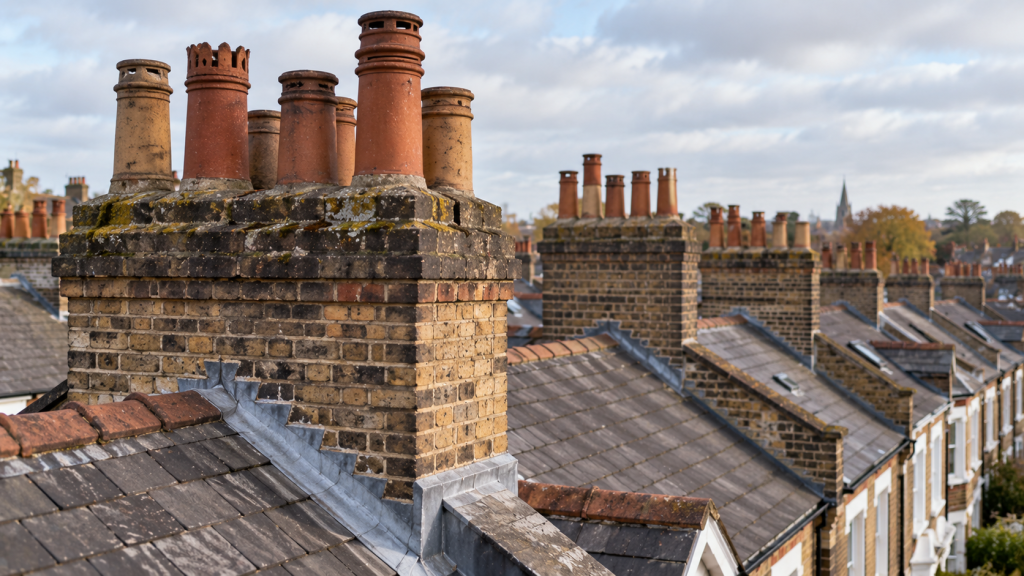
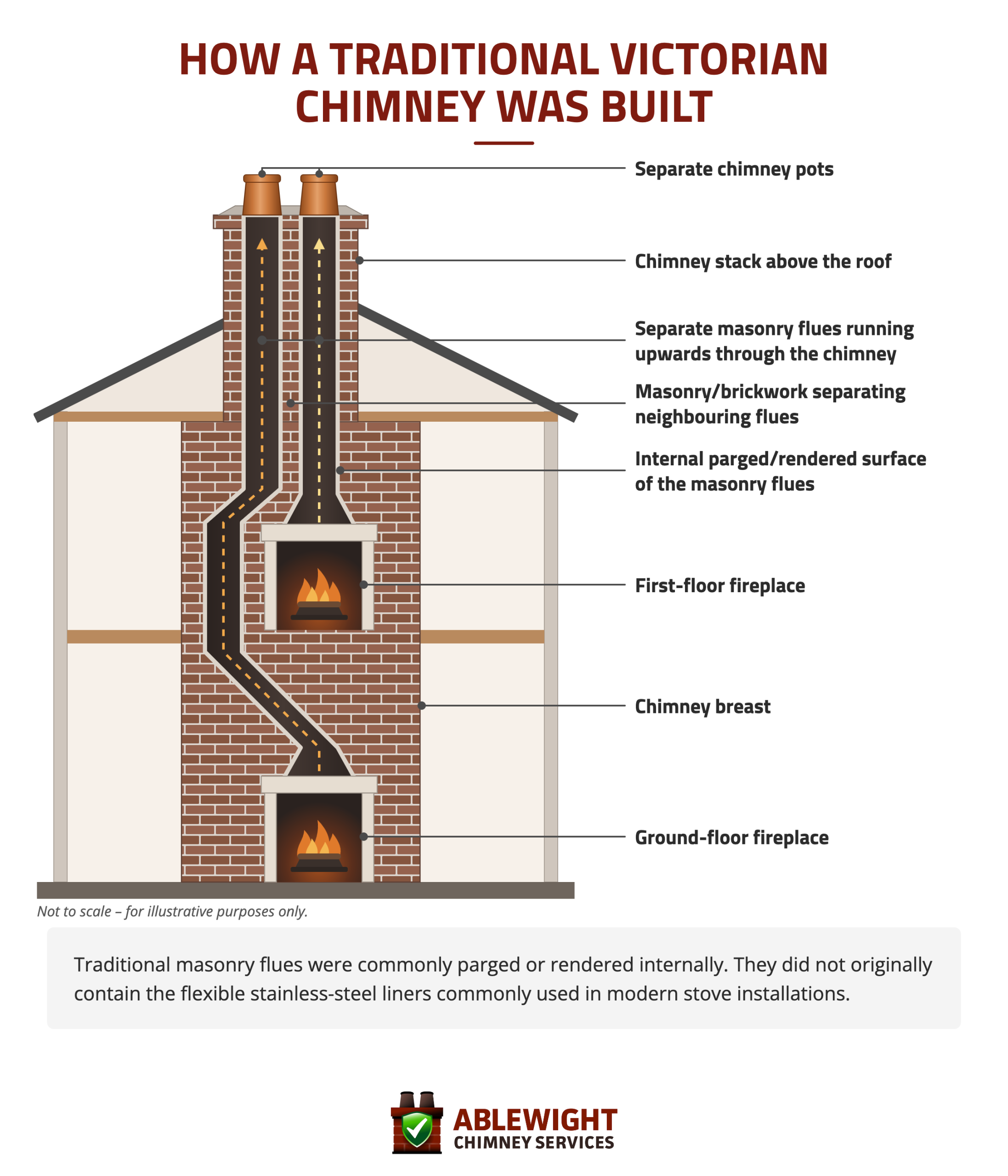
A traditional chimney is part of the masonry structure of the house. A fireplace at room level connects into a flue running upwards through the chimney breast and chimney stack before terminating at a chimney pot above the roof.
In houses with fireplaces in several rooms, the chimney breast and stack can contain several separate flues. These may rise alongside one another before emerging through their own chimney pots.
The internal surfaces of older masonry flues were commonly parged or rendered. This provided a smoother internal surface and helped separate the flue gases from the surrounding brickwork.
Although we associate this construction particularly with Victorian houses, traditional masonry flues continued to be used in British homes long after the Victorian period. We therefore encounter similar chimney construction in later properties too.
Were Victorian chimneys lined?
This depends on what we mean by a liner.
A Victorian chimney would not originally have contained the flexible stainless-steel liner that many homeowners now associate with a lined chimney. Instead, the masonry flue itself formed the chimney, with its internal parged or rendered surface providing the flue finish.
That distinction matters because an old masonry flue and a modern flexible liner are two different systems. If you would like a straightforward explanation of the different types, see What Is a Chimney Liner?.
Why do Victorian chimneys often have multiple flues?
Many period houses were built with more than one fireplace. A property might have had fires serving different rooms and different floors, with each fireplace requiring its own route for combustion gases to escape.
This is why a single chimney breast or stack can contain several neighbouring flues. From inside the house, it may not be obvious how those flues travel through the masonry or how closely they run alongside one another.
The dividing structure between neighbouring flues is sometimes referred to as a chimney feather or mid-feather. If this separating material deteriorates sufficiently, smoke from one active flue can potentially find a route into an adjoining flue rather than remaining completely contained within its intended passage.
We carry out a smoke test as part of every chimney sweep, and a failed smoke test can be one of the clearest signs that separation between neighbouring flues has deteriorated. A customer noticing smoke or a smoke smell in an upstairs room can also indicate a problem, although there are other possible causes and the source needs to be established rather than assumed.
Why do old masonry chimney flues deteriorate?
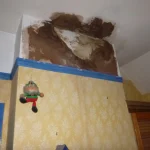
A chimney that has been standing for well over a century has experienced decades of heating and cooling, combustion deposits, moisture and changes to the building around it. The internal parging, mortar and masonry do not necessarily remain in their original condition indefinitely.
Soot and other combustion deposits can also interact with moisture and contribute to damaging conditions within the chimney. This is one reason regular sweeping matters: as well as keeping the flue clear, sweeping removes deposits from its internal surfaces.
Previous building work can add another variable. Fireplaces may have been opened, closed, altered or brought back into use at different points in the property’s history. What exists today is therefore not necessarily exactly what was built originally.
Common problems we encounter in older masonry chimneys
Being Victorian does not automatically mean that a chimney has a problem. Equally, age alone does not tell us whether a flue is suitable for a particular use. The condition and history of the individual chimney matter.
Problems that can occur in older masonry chimney systems include:
- deterioration of the internal parging, mortar or masonry;
- debris falling into the fireplace or flue;
- leakage between adjoining flues where the material separating them has deteriorated;
- smoke or smells appearing in another room or neighbouring flue;
- heavy soot, tar or other deposits from previous use;
- problems caused by fireplaces or flues having been incorrectly blocked or altered.
These symptoms do not all have one cause, so the appropriate investigation depends on what has actually been found. Our guide to Chimney Liner Problems: Signs, Causes and What to Do explains several of these issues in more detail.
What if you want to install a modern wood-burning stove?
An old chimney does not automatically need a flexible stainless-steel liner simply because it is Victorian or because it has reached a particular age.
The proposed appliance, the existing flue and its condition all need to be considered. The stove installer should survey the chimney and specify the appropriate flue arrangement for the installation.
In practice, flexible stainless-steel liners are commonly fitted as part of modern stove installations, but whether one is required in a particular chimney is an installation decision rather than something that can be determined from the age of the house alone. See Do I Need a Chimney Liner? for more detail.
Planning a stove installation?
Have the existing chimney swept before the new stove or liner is installed. This removes old deposits while the original flue is still accessible and can reveal useful information during sweeping. Read why we recommend sweeping before stove or liner installation.
Does an old masonry chimney need a CCTV survey?
Not routinely. We would not recommend a CCTV survey simply because a chimney is Victorian or old.
If there is a specific problem that needs further investigation, a CCTV chimney survey may provide useful additional information about accessible parts of the flue. The need for further investigation should be based on the circumstances rather than the age of the property alone.
What should you do if you have an older chimney?
If the chimney is in use, appropriate regular sweeping is the starting point. If you are bringing a disused fireplace back into use, changing the appliance or have noticed a particular problem, the next step depends on what you intend to use the chimney for and what has been found.
Old chimneys can continue to perform their job for many years. The important point is not to assume that every Victorian chimney is defective — or, at the other extreme, that because it has worked for decades it must still be suitable for any modern appliance without assessment.
Need your chimney swept or concerned about an older flue?
Tell us about your fireplace or appliance and anything you have noticed. We can arrange chimney sweeping and advise whether there is a specific reason for further investigation.
Frequently asked questions
Do Victorian chimneys have liners?
They generally do not have the separate flexible stainless-steel liner people often mean by a chimney liner today. Traditional masonry flues were formed within the chimney structure and commonly had an internal parged or rendered surface. A modern liner may have been added later.
Does a Victorian chimney need a modern liner?
Not automatically. Whether a liner is needed depends on the appliance being installed, the existing flue and its condition. For a stove installation, the installer should assess the chimney and specify the appropriate flue arrangement.
Can smoke leak between old chimney flues?
Yes. In a traditional masonry chimney, neighbouring flues are separated by brickwork, mortar and the internal parged or rendered surfaces. Over time, these materials can deteriorate, crack or break away, creating gaps between the flues.
If that happens, smoke travelling up one flue can escape through those gaps into the neighbouring flue. It may then appear at another fireplace or in another room connected to that flue.
Smoke passing between flues is not normal and should be investigated to establish where the leakage is occurring.