
Problems with a chimney flue or liner are not always obvious from inside the room. Some are found during routine sweeping, while others first become apparent because of smoke smells, poor draught, falling masonry or deposits inside the flue.
At Ablewight, the problems we encounter differ depending on whether the chimney contains a flexible stainless-steel liner or is an older masonry flue. Just as importantly, something found inside a liner is not necessarily a fault with the liner itself.
In This Guide
Problems with stainless-steel chimney liners
Flexible stainless-steel liners are commonly used with wood-burning and multi-fuel stoves. When we sweep them, there are several problems we sometimes encounter.
Signs of deterioration or corrosion
One of the clearest signs we encounter during sweeping is small flakes or fragments of the stainless-steel liner coming down the chimney. These pieces can sometimes have a rusty or reddish-brown appearance.
Stainless steel is corrosion resistant, but it is not completely immune to corrosion. When corrosion attacks the metal it can cause pitting and deterioration, and the iron within stainless steel can oxidise to produce the reddish-brown material we recognise as rust. Finding liner fragments during sweeping is therefore something we take seriously rather than simply treating them as ordinary chimney debris.
A routine chimney sweep is not a full liner-condition survey, so what happens next depends on what has been found and the extent of the concern. Where there is a specific reason to investigate further, additional inspection may be appropriate.
A liner installed in the wrong direction
Some flexible stainless-steel liners have a specified installation direction. Where that applies, we occasionally encounter liners that have been installed upside down. The manufacturer’s installation instructions for the particular liner should always be followed.
An incorrectly finished liner at the chimney top
A flexible stainless-steel liner is formed as a spiral. Once it has been cut at the top of the chimney, it needs to be correctly terminated using the appropriate components for that lining system.
If the cut spiral is left inadequately protected, a sweeping brush can catch on the exposed edge. This may not destroy the liner on the first sweep. Instead, repeated contact over a number of sweeping visits can progressively unravel it. With annual sweeping, that deterioration may develop over several years.
Important: where a correctly used sweeping brush catches an improperly terminated cut liner and the liner progressively unravels, the underlying problem is the installation of the liner rather than normal chimney sweeping.
Tar inside a liner doesn’t necessarily mean the liner is faulty
Heavy tar deposits can build up inside a stainless-steel liner and, in severe cases, contribute to chimney-fire risk. However, the tar is generally a symptom of how the appliance has been fuelled or operated rather than a defect in the stainless-steel liner itself.
Wet or unsuitable fuel and prolonged cool or inefficient burning can contribute to tar and creosote formation. The deposit appears inside the liner, but replacing the liner without addressing the cause would not solve the underlying problem.
For more on this, see our guide to creosote and tar in chimneys.
Problems with unlined masonry flues
Older masonry chimneys can develop a different set of problems. These are often less obvious than damage to a metal liner because the flue is formed within the chimney structure itself.
Deteriorating mortar and leakage between flues
Over time, mortar between the bricks inside a chimney can deteriorate. Combustion deposits and moisture can contribute to deterioration within the flue. Rather than creating one obvious hole, the loss of mortar can create many small leakage paths between bricks.
This can allow smoke and combustion gases to pass from one flue into an adjoining flue. As the mortar deteriorates further, bricks can also become loose and pieces of mortar or masonry may fall down the chimney.
A flue that is unsuitable for the fireplace
The size and arrangement of a flue affect the draught needed to carry combustion gases safely away from a fire. If the flue is unsuitable for the fireplace or appliance, the fire may not draw properly and smoke can spill back into the room.
Smoke entering the room therefore does not automatically mean the chimney is blocked or that it simply needs sweeping. The relationship between the fireplace, flue, ventilation and chimney needs to be considered.
The wrong chimney terminal on a live flue
A chimney terminal is not purely decorative. An inappropriate terminal on a working flue can interfere with its operation and contribute to draught or smoke problems. The terminal needs to be suitable for the appliance, fuel and flue arrangement.
Why can you smell smoke in an upstairs bedroom?
If you can smell smoke in an upstairs bedroom while a fire is burning downstairs, the problem isn’t necessarily in the bedroom itself. In our experience, two causes worth considering are leakage between adjacent flues and syphonage.
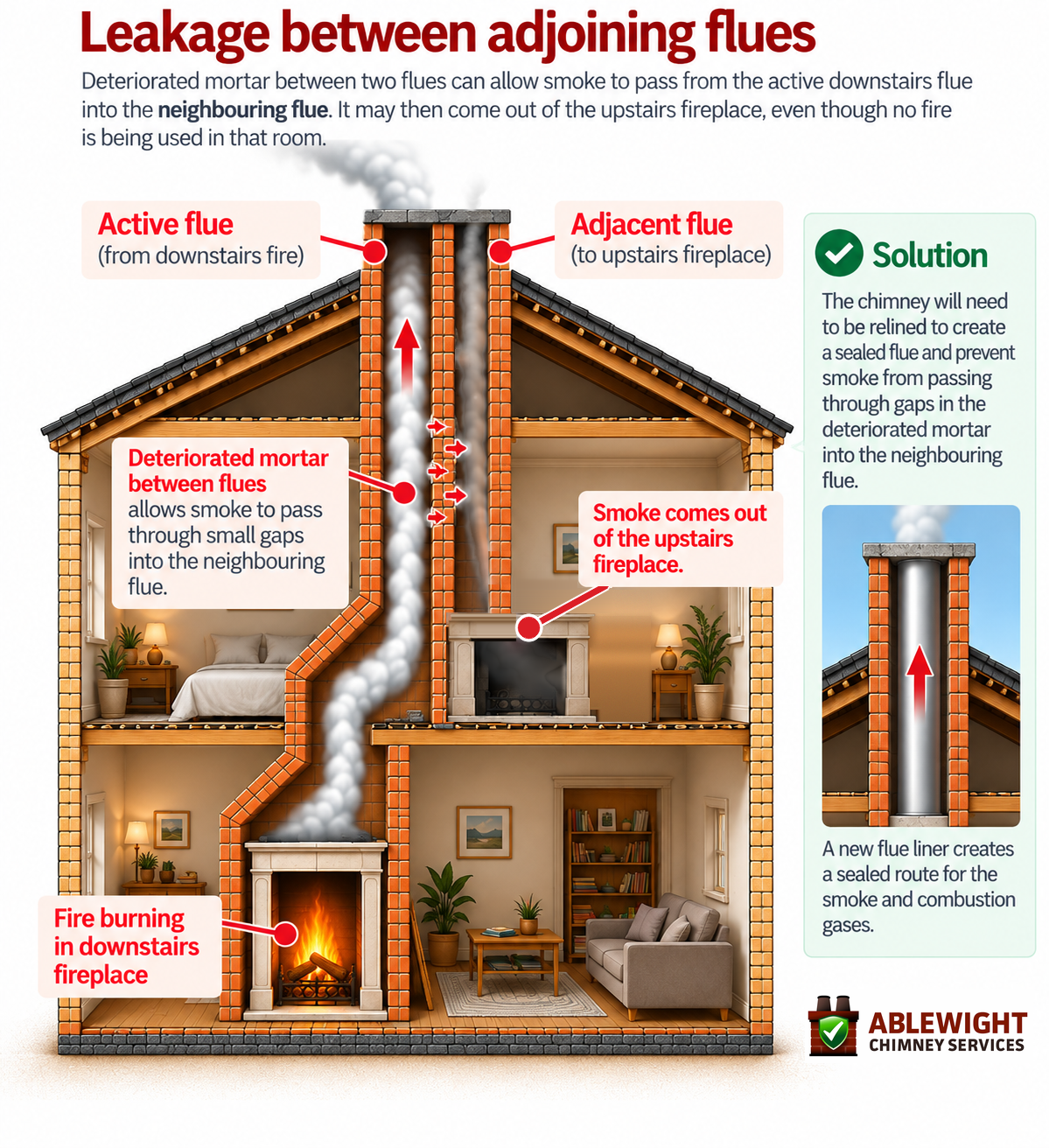
1. Smoke leaking between adjoining flues
If mortar has deteriorated between two masonry flues within the same chimney, smoke from the downstairs fire can find its way through small gaps and into the neighbouring flue. It may then become noticeable at an unused fireplace or chimney opening upstairs.
The leakage may consist of numerous tiny gaps rather than one easily visible defect, which is why the source is not always obvious from inside the room.
2. Syphonage between neighbouring chimney pots
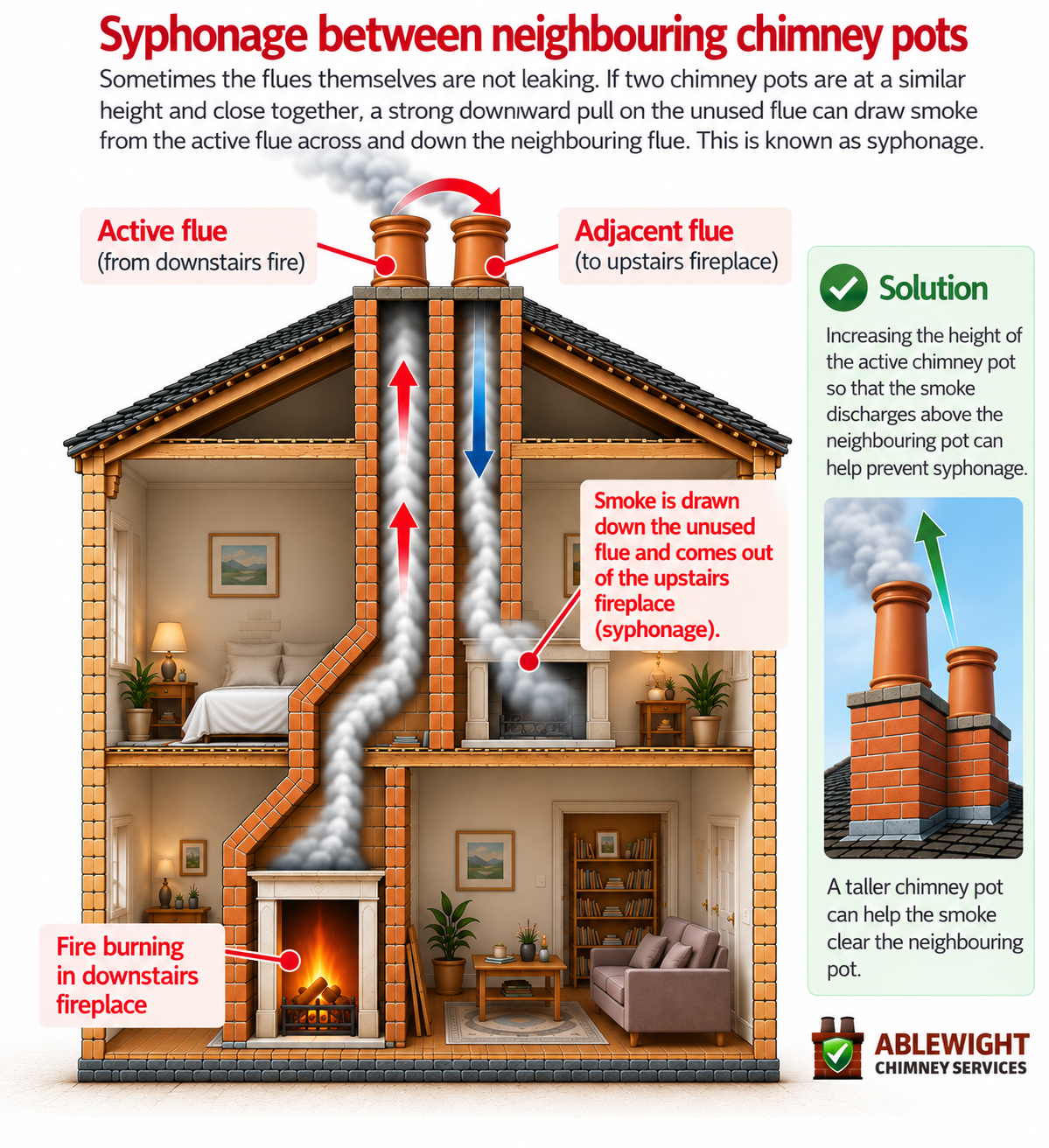
Sometimes the flues themselves are not leaking. If the active downstairs flue and an unused upstairs flue terminate close together at approximately the same height, the unused flue can develop a strong downward pull. Smoke leaving the downstairs chimney can then be drawn into the neighbouring chimney pot and down the upstairs flue.
This is known as syphonage. In our experience it accounts for a minority of these cases, but it is important to rule out because the remedy can be much simpler than repairing a leaking masonry flue.
Depending on the particular chimney arrangement, increasing the height of the active downstairs flue’s chimney pot so that the smoke discharges above the neighbouring pot can sometimes resolve the problem. The cause should be established before alterations are made.
Problems caused by incorrectly blocking a chimney
We also encounter problems that have been created after a fireplace has stopped being used.
Newspaper, cushions, pillows and other materials are sometimes pushed into a chimney simply to stop the draught. This restricts airflow through the flue and can increase moisture problems, contributing to damp or staining around the chimney.
Another common mistake is permanently closing a fireplace without having the chimney swept first or without considering ventilation. Soot and tar can be left trapped inside, while an incorrectly closed chimney can retain moisture rather than allowing the structure to dry.
If a chimney is being permanently taken out of use, the way it is treated at the bottom needs to correspond with what happens at the top. We explain the options in How to Permanently Block a Chimney or Fireplace.
Other problems can mimic a damaged liner
Not every chimney problem is caused by a liner. Fallen masonry, debris, bird nesting material and other obstructions can restrict a flue and produce poor draught or smoke problems. A known chimney fire can also create a reason to investigate the condition of the flue or liner rather than assuming that sweeping alone establishes that everything is sound.
If you suspect a blockage, see Blocked Chimney: Signs, Causes, Risks and What to Do.
How are chimney and liner problems investigated?
The right investigation depends on the symptom. A routine chimney sweep can reveal some problems — such as deposits, debris or visible signs of deterioration encountered during sweeping — but it is not a full structural survey of the chimney.
Where there is a specific reason to investigate inside an accessible flue, a CCTV chimney survey may help provide additional information. Other problems may instead require a stove installer, builder or other appropriate specialist depending on what is found.
Concerned about something you’ve noticed with your chimney?
Tell us what you’ve noticed when you contact us. We can help determine whether chimney sweeping, a CCTV survey or another next step is appropriate.
Frequently asked questions
What are the signs of a damaged chimney liner?
Possible signs include small flakes or fragments of stainless steel found during sweeping, sometimes with a rusty or reddish-brown appearance. Smoke or poor draught alone does not prove that a liner is damaged because several other chimney, appliance and ventilation problems can produce similar symptoms.
Does tar inside a stainless-steel liner mean it needs replacing?
Not necessarily. Tar is usually related to combustion conditions, fuel or how the stove is being operated rather than being a defect in the liner itself. The deposit and its underlying cause both need to be addressed.
Why can I smell my downstairs fire in an upstairs bedroom?
Two possibilities are leakage between adjoining masonry flues and syphonage between neighbouring chimney pots. Leakage can occur where mortar has deteriorated between flues. Syphonage can occur when smoke leaving one pot is drawn down an adjacent unused flue. The remedy is different, so identifying the cause matters.
Can chimney sweeping damage a stainless-steel liner?
A correctly installed liner should be suitable for normal maintenance using appropriate sweeping equipment. One problem we encounter is an inadequately terminated cut liner at the chimney top: a brush can catch the exposed spiral and progressively unravel it over repeated visits. In that situation the underlying fault is the liner installation, not normal sweeping.
Do I need a CCTV survey if I suspect a liner problem?
Not automatically. CCTV is useful where there is a specific reason to investigate the accessible interior of a flue, but the appropriate next step depends on the problem. Tell us what you have noticed and we can advise whether CCTV is likely to be useful.