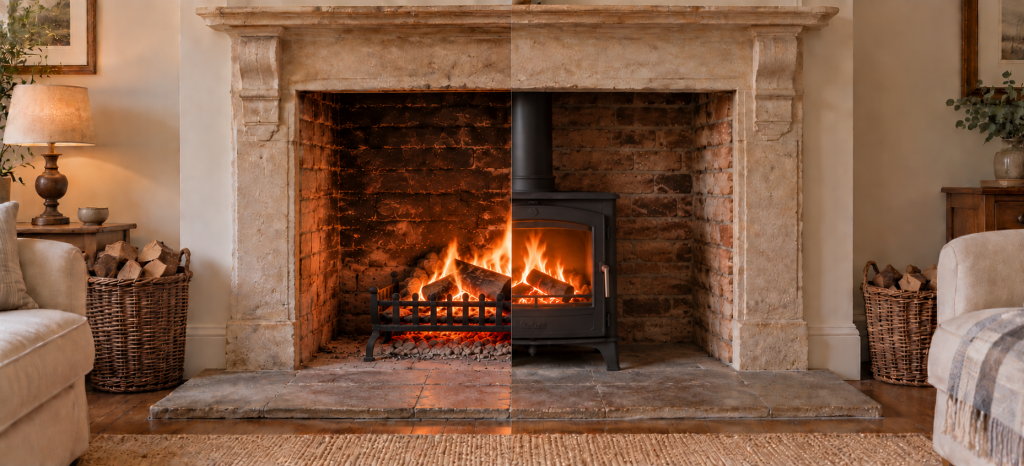
If you’re deciding between keeping an open fire and installing a wood-burning stove, the biggest differences are how the fire is controlled, how much useful heat you get from the fuel, and the smoke produced while burning.
A stove isn’t automatically the right choice for every home. An open fireplace may be an original feature you want to retain, while a stove can provide more controlled heating. The right choice depends on how you want to use the fireplace, the property and chimney, and any local restrictions.
In This Guide
- What’s the Difference Between a Wood Burner and an Open Fire?
- Wood Burner vs Open Fire: Which Gives More Useful Heat?
- Does a Stove Use Less Fuel Than an Open Fire?
- Do Stoves Produce Less Smoke Than Open Fires?
- Is a Stove More Work to Maintain Than an Open Fire?
- Should I Choose a Stove or Keep an Open Fire?
- Frequently Asked Questions
What’s the Difference Between a Wood Burner and an Open Fire?
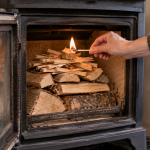
An open fire burns fuel in an open fireplace. Airflow through the fire is much less controlled, and a substantial amount of the heat produced is carried up the chimney with the combustion gases.
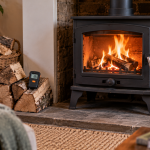
A wood-burning stove burns wood inside a closed appliance. A multi-fuel stove is designed to burn wood as well as other suitable solid fuels. Typically, it has a grate that allows ash to fall into an ashpan below and lets air circulate up through the fuel bed. This is important for fuels such as smokeless coal, which need air from underneath to burn effectively. The stove’s air controls regulate combustion, while the body of the appliance transfers heat into the room.
Throughout this guide, where the same principle applies to both wood-burning and multi-fuel appliances, we use “stove” for simplicity.
That basic difference — an open fire versus a controlled, enclosed appliance — explains many of the differences in heat output, fuel use and emissions.
Wood Burner vs Open Fire: Which Gives More Useful Heat?
A modern stove will deliver more useful heat to the room from its fuel than an open fire.
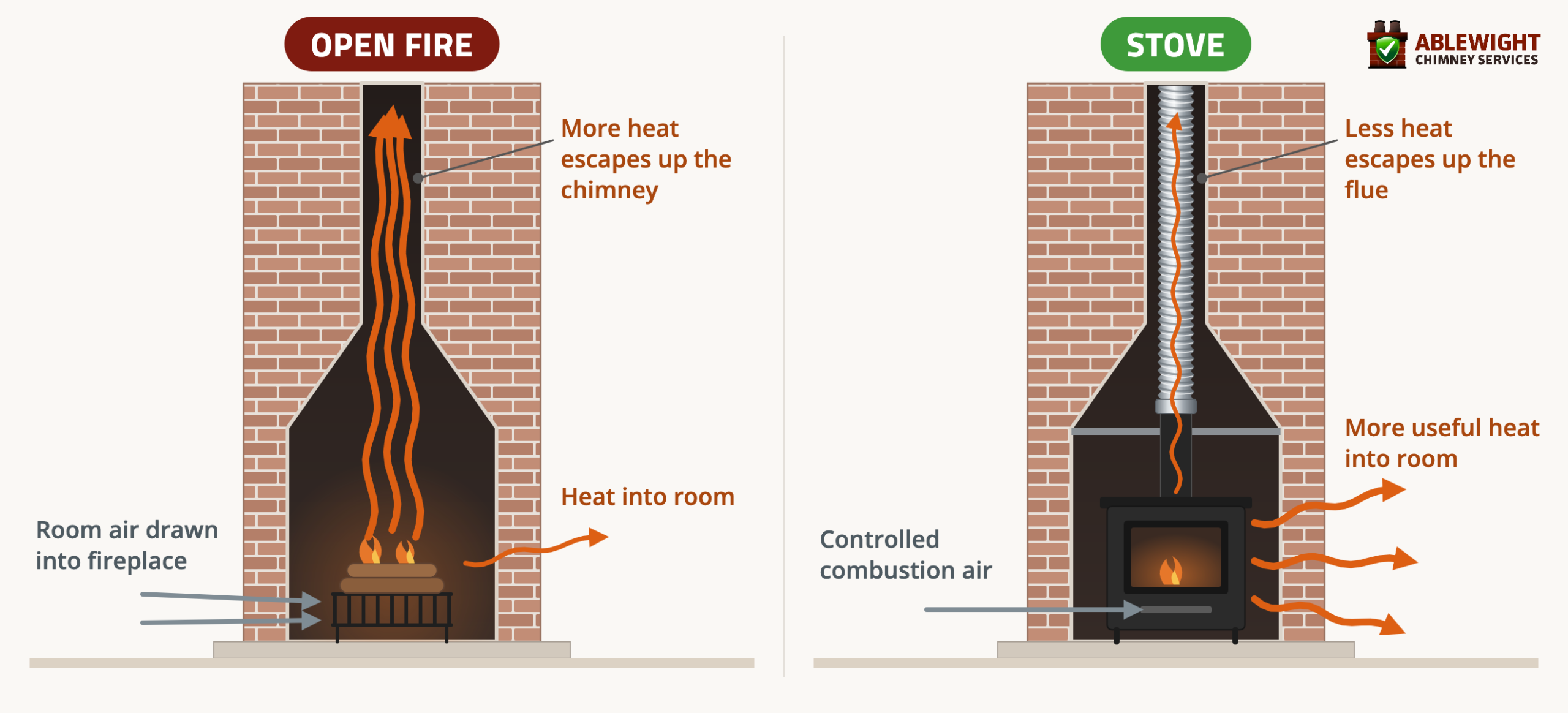
With an open fireplace, a significant proportion of the heat goes up the chimney. The chimney also draws air from the room while the fire is burning.
A closed stove gives much greater control over combustion and is designed to transfer heat into the room rather than allowing as much of it to escape directly up the flue.
That doesn’t mean every stove has the same efficiency. Performance varies between appliances, so if you’re considering a particular stove, look at the manufacturer’s stated efficiency and heat output rather than relying on a generic figure.
Does a Stove Use Less Fuel Than an Open Fire?
Because a stove can extract more useful heat from its fuel, you would generally expect it to use less fuel than an open fire to provide a comparable amount of useful heat.
Actual fuel use depends on the appliance, the size of the room, how the fire is operated and the fuel being burned.
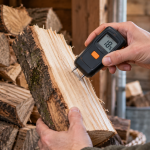
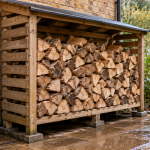
If you’re burning wood — whether in a wood-burning stove, a suitable multi-fuel stove or an open fire — it should be dry, with a moisture content of 20% or less. Multi-fuel stove owners should always follow the manufacturer’s instructions about which other fuels are suitable for their appliance.
Our guide to seasoned wood explains why moisture matters, while our guide to fuels for stoves and open fires covers what you can and cannot burn.
Do Stoves Produce Less Smoke Than Open Fires?
Modern stoves are designed to burn fuel in a more controlled way than an open fire. Current government guidance states that wood-burning stoves produce much less smoke than open fires and recommends considering an Ecodesign stove when buying a new appliance.
However, burning wood in either an open fire or a stove produces particulate pollution. The appliance is only part of the picture: dry fuel, correct operation and proper maintenance all matter.
If you’re buying a new stove, new solid-fuel stoves placed on the UK market have had to meet Ecodesign requirements since January 2022.
Local rules matter too. In a Smoke Control Area, what you can burn depends on the appliance and fuel. Wood can only be burned in an appliance that is exempt for use with that fuel; an open fire would instead need an authorised fuel.
Cambridge has its own Smoke Control Area, which we cover in our dedicated Cambridge Smoke Control Area guidance.
Is a Stove More Work to Maintain Than an Open Fire?
Both need the chimney or flue swept, but a stove also has components that an open fireplace doesn’t.
With a stove, maintenance can include checking the door rope seal, firebricks, glass, baffle or throat plate and other accessible components. This is why chimney sweeping and stove servicing are separate jobs.
An open fire doesn’t need a stove service, but the chimney still needs sweeping and the fireplace and surrounding area should be kept in suitable condition.
If you already own a stove, our Wood-Burning & Multi-Fuel Stove Maintenance Guide explains the routine checks you can make yourself.
Should I Choose a Stove or Keep an Open Fire?
If your priority is getting more controlled, useful heat from burning wood, a modern stove has clear practical advantages over an open fire.
But heating performance isn’t the only consideration.
You may value an original open fireplace as part of the character of the property, particularly if you only use it occasionally. Installing a stove is also a bigger undertaking than simply continuing to use an existing, serviceable open fireplace.
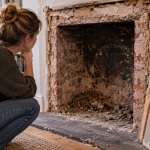
If you’re considering converting an open fireplace to a stove, the existing chimney should be swept before installation. The installer will then need to determine what is required for that particular stove and chimney.
See our guide to sweeping before a stove installation for more information.
Planning to Install a Stove?
If you’re replacing an open fire with a wood-burning or multi-fuel stove, the chimney should be swept before installation. We can sweep the chimney ready for your installer and issue a Guild of Master Chimney Sweeps sweeping certificate.
Frequently Asked Questions
Is a stove more efficient than an open fire?
Yes. A closed wood-burning or multi-fuel stove is designed to control combustion and transfer more of the heat produced into the room, whereas an open fire loses a greater proportion of its heat up the chimney. The exact efficiency varies between stove models, so check the manufacturer’s stated efficiency for the individual appliance.
Can I put a wood-burning stove in an existing fireplace?
Often, but whether a particular fireplace and chimney are suitable needs to be established as part of the installation. The chimney should be swept before the stove is installed so that it is clear and accessible for the installer to assess.
Can I burn the same wood on an open fire and in a stove?
Dry, untreated firewood may be suitable for both, but always follow the stove manufacturer’s fuel instructions. If you’re in a Smoke Control Area, additional restrictions apply to the appliance and fuel you can use.
Do open fires, wood-burning stoves and multi-fuel stoves all need the chimney swept?
Yes. Burning solid fuel produces deposits in the chimney or flue, so open fires, wood-burning stoves and multi-fuel stoves all need regular sweeping. How often is appropriate depends on factors including the fuel, frequency of use and the condition of the chimney.