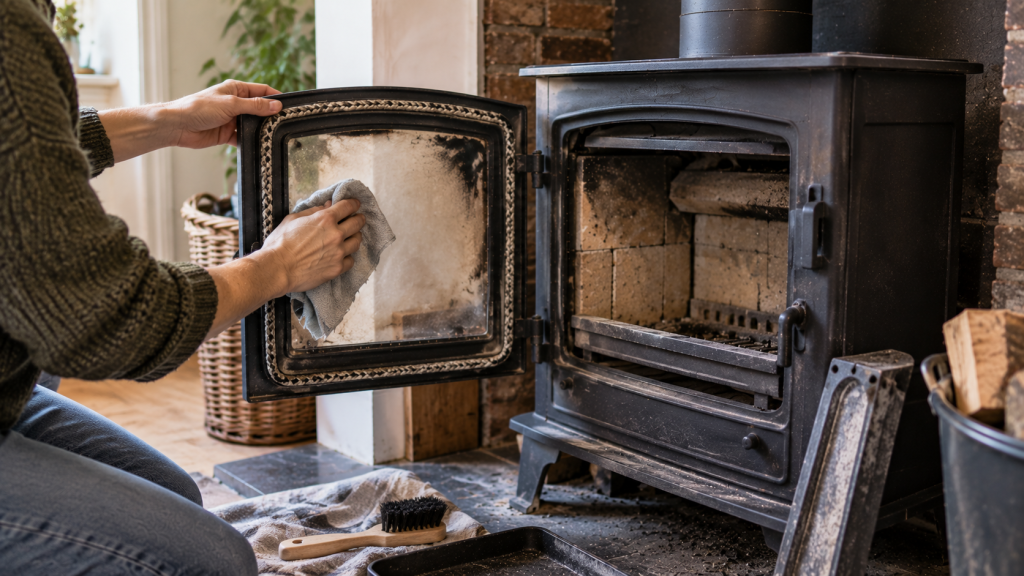
A wood-burning or multi-fuel stove doesn’t need constant professional attention, but it does need looking after. Some maintenance is straightforward enough to do yourself, while other jobs involve dismantling and checking parts of the appliance and are better dealt with as part of a professional stove service.
A quick note on terminology: throughout this guide, we use the word “stove” to refer to both wood-burning and multi-fuel stoves. The maintenance advice below applies to both unless we specifically say otherwise.
There’s also an important distinction that often causes confusion: having your chimney swept is not the same as having your stove serviced. The chimney or flue needs sweeping at the appropriate frequency regardless of whether the stove itself is due for a service.
This guide explains what stove maintenance you can reasonably do yourself, what happens during a professional service, how often servicing is usually needed and how to look after your stove when you stop using it for the summer.
In This Guide
- What stove maintenance can you do yourself?
- How much ash should you leave in a stove?
- How can you check your stove door seal?
- What shouldn’t you dismantle yourself?
- What’s included in a professional stove service?
- How often should a stove be serviced?
- Is stove servicing the same as chimney sweeping?
- How should you leave your stove over the summer?
- When should you get your stove checked?
- Frequently asked questions
What Stove Maintenance Can You Do Yourself?
You don’t need to wait for a professional service to take care of the basics. There are several simple jobs that can help you keep an eye on the condition of your stove between services.
Remove Excess Ash
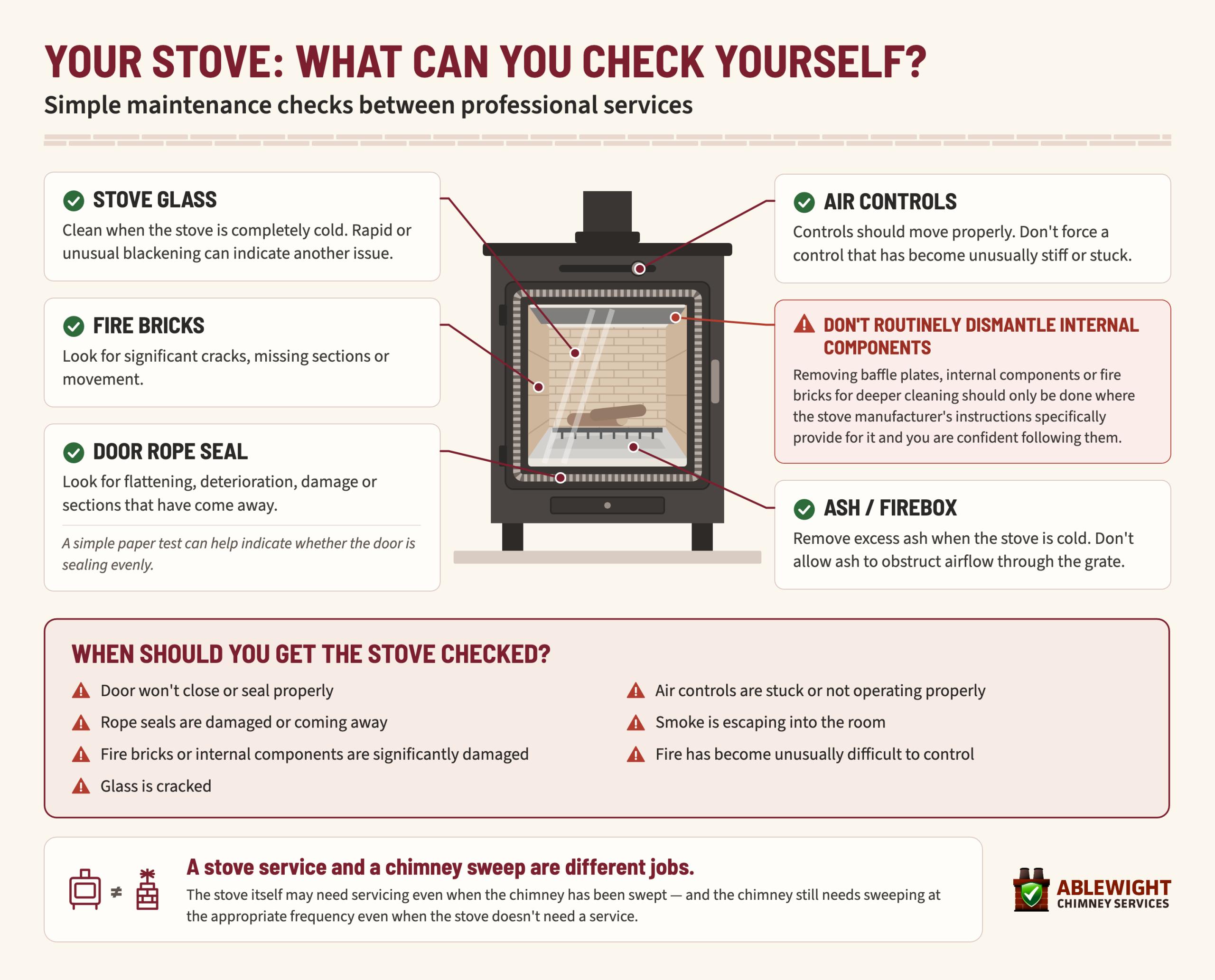
Once the stove is completely cold, you can remove excess ash from the firebox or ash pan. You don’t necessarily need to leave the firebox spotless between fires.
If your stove has grate or griddle bars, leaving roughly an inch of ash can provide some protection from the heat of the next fire. However, you need to balance this against the stove’s need for adequate airflow. Ash shouldn’t build up to the point that it obstructs air passing through the grate.
During an Ablewight stove service, most customers prefer us to clean the ash from the stove as part of the work, so we normally leave it clean afterwards.
Clean the Stove Glass
Stove glass will gradually accumulate deposits through normal use. You can clean it yourself when the stove is completely cool, using a product suitable for stove glass and following the stove manufacturer’s instructions.
If the glass becomes unusually dirty very quickly, repeatedly blacks up or is damaged, it may be worth looking beyond the cleaning itself. How the stove is being operated, the fuel being burned and the condition of the appliance can all play a part.
Clean the Outside of the Stove
You can wipe down the external surfaces as part of routine cleaning, following the manufacturer’s instructions for your particular appliance.
If you notice rust or deterioration of the stove finish, contact the stove manufacturer for advice on the correct treatment or product rather than simply painting or treating it yourself. Different stove finishes can require different products.
Look at the Fire Bricks
Fire bricks line the inside of many solid-fuel stoves and help protect the body of the stove from the heat of the fire. They can crack or deteriorate over time.
You don’t need to dismantle the stove to inspect them, but it’s worth looking at the visible bricks occasionally so you notice significant cracks, missing sections or movement.
If they need replacing, we can fit replacement fire bricks during a stove service, but we don’t supply the bricks. Order the correct replacements from your stove manufacturer and have them ready for your appointment. If you’re unsure who manufactured the stove, a clear photograph and an image-search tool such as Google Lens can sometimes help identify it.
Check the Door Rope Seal
The rope seal around the stove door helps it close correctly. You can visually check the rope for obvious deterioration, flattening, damage or sections that have come away.
There’s also a simple test homeowners can use. Place a piece of paper between the door and the stove, close the door and gently try to pull the paper out. Repeat this at several points around the door. You should feel resistance. If the paper slips out very easily in a particular area, the seal may need attention.
This isn’t how we professionally test a stove. We use smoke pellets as part of our testing. However, the paper test can be a useful indication for a homeowner who doesn’t have smoke pellets or know how to carry out a smoke test safely.
Check the Air Controls
Your stove’s air controls should move properly. If a control has become unusually stiff, stuck or difficult to operate, don’t force it. Air controls are checked during our stove servicing and can be lubricated where appropriate.
What Shouldn’t You Dismantle Yourself?
Basic cleaning and visual checks are one thing; dismantling the internal components of the stove is another.
We don’t recommend that homeowners start removing baffle plates, internal components or fire bricks simply to carry out a deeper clean unless their stove manufacturer specifically provides instructions for them to do so and they’re confident following them.
Removing, cleaning and checking the internal parts of the stove forms part of our professional stove service. Different stove models are constructed differently, and components need to be put back correctly. A professional service also gives us an opportunity to look for wear or deterioration while those parts are removed.
What’s Included in an Ablewight Stove Service?
We service solid-fuel stoves, including both wood-burning and multi-fuel appliances.
During a stove service we:
- remove, clean and check the internal parts;
- clean the stove and glass;
- check the seals around the door, access hatches and stove pipe;
- replace rope, cement and silicone seals where required;
- check the air controls and lubricate them if they’re stiff; and
- fit replacement fire bricks or door glass where required, provided you have supplied the correct replacement parts.
We also use smoke pellets when testing rather than relying on simple homeowner checks such as the paper test.
The service is recorded on your documentation and invoice, giving you a record of the work carried out. For service details, see our wood-burning and multi-fuel stove servicing page.
Stove servicing needs to be booked in advance. It isn’t automatically included when you book a chimney sweep.
Need Your Stove Serviced?
If your stove is due for servicing, let us know when requesting your appointment. If you also need the chimney swept, request both services so we can allow sufficient time.
How Often Should a Wood-Burning or Multi-Fuel Stove Be Serviced?
Stove manufacturers commonly recommend annual servicing, and this can be particularly important while the appliance is under warranty. Always check the maintenance schedule supplied by the manufacturer of your particular stove.
If annual servicing is a condition of the warranty, failing to follow that schedule could affect a later warranty claim. Outside the warranty period, the practical requirement can be different.
In our experience, a normally used stove will often be fine with a professional service every two to three years, while a stove receiving particularly heavy use may benefit from more frequent servicing.
For more detail on maintenance conditions and records, see Stove & Chimney Liner Warranties: Why Sweeping and Servicing Matter.
Chimney Sweeping and Stove Servicing Are Different Jobs
A stove service maintains the appliance. A chimney sweep cleans the chimney or flue. Having one done doesn’t automatically mean you’ve had the other.
Your chimney needs sweeping at an appropriate frequency even if the stove itself isn’t due for a full service. For most normally used domestic stoves, we generally find that annual chimney sweeping is suitable. However, the appropriate frequency depends on the fuel being burned, how heavily the stove is used and the deposits found. Published guidance can recommend more frequent sweeping in some circumstances.
For more guidance, see How Often Should You Sweep Your Chimney? or our professional chimney sweeping service.
When the chimney is safe to use following our work, we provide a Guild of Master Chimney Sweeps sweeping certificate, giving you a dated record of the sweep.
How Should You Leave Your Stove Over the Summer?
When you’ve finished using your stove for the warmer months, it’s a good opportunity to have the chimney swept, have the stove serviced if it’s due, clean out the stove as required and deal with anything that needs attention before the next burning season.
But there’s another important step once you’ve finished:
Close the stove door, but leave the stove’s air vents open.
It can be tempting to shut everything down completely because the stove won’t be used for several months. However, keeping the air vents open allows air to continue flowing through the stove and chimney. Closing the stove up without adequate ventilation can restrict that airflow and contribute to problems while the stove is unused.
It’s a very simple habit, but one many stove owners aren’t aware of.
When Should You Get Your Stove Checked?
Routine cleaning doesn’t solve every problem. We’d recommend getting professional advice if you notice:
- the stove door doesn’t close or seal properly;
- rope seals are damaged or coming away;
- fire bricks or other internal components are significantly damaged;
- the glass is cracked;
- an air control is stuck or isn’t operating properly;
- smoke is escaping into the room;
- you’re finding the fire unusually difficult to control; or
- you can see other damage or deterioration you’re unsure about.
These symptoms don’t necessarily mean there’s a fault with the stove itself. Problems with fuel, airflow or the chimney can also affect how a stove behaves. If you’re experiencing smoke entering the room or another significant change in how the stove operates, don’t assume that a quick clean will resolve it.
A Simple Stove Maintenance Routine
Most stove maintenance isn’t complicated. The useful habit is simply paying attention to the appliance rather than waiting until something stops working.
Cleaning the glass and firebox gives you an opportunity to notice deteriorating rope seals, damaged fire bricks or controls that are becoming stiff. Professional servicing then goes further by allowing the internal components to be removed, cleaned and checked properly.
Combined with regular chimney sweeping, that gives you a straightforward maintenance routine without treating the stove as something that needs constant professional intervention.
Chimney Due for a Sweep or Stove Service?
If you’d like us to sweep your chimney, service your stove or carry out both during the same visit, tell us what you require when requesting your appointment so we can allocate the appropriate time.
Frequently Asked Questions
Can I maintain my stove myself?
You can carry out routine jobs such as removing excess ash, cleaning the glass and external surfaces, visually checking fire bricks and rope seals, and making sure the air controls move properly. We don’t recommend dismantling the internal components for routine cleaning; removing, cleaning and checking these components is part of our professional stove service.
Does this maintenance advice apply to multi-fuel stoves?
Yes. Throughout this guide, “stove” covers both wood-burning and multi-fuel stoves unless we specifically say otherwise. We service both types of solid-fuel appliance.
How much ash should I leave in my stove?
Around an inch can help protect grate or griddle bars from the heat of the next fire, but it shouldn’t be allowed to obstruct airflow through the stove. Follow the manufacturer’s instructions for your particular appliance.
How can I tell if my stove door rope needs replacing?
Look for obvious damage, deterioration or areas where the rope has become heavily compressed. A simple homeowner check is to close the stove door on a piece of paper and gently try to pull it out. If there’s very little resistance in part of the door, the seal may need attention. During professional servicing we use smoke pellets for testing.
Should I remove the baffle plate to clean my stove?
We don’t recommend routinely dismantling your stove unless its manufacturer specifically provides instructions for you to do so and you’re confident carrying them out. Removing, cleaning and checking internal components forms part of our professional stove service.
Does my stove need servicing every year?
Manufacturers commonly recommend annual servicing, particularly while a stove is under warranty. Check the requirements for your particular appliance. Outside the warranty period, we generally find that servicing every two to three years is adequate for many normally used stoves, while heavily used appliances may need more frequent attention.
Does my chimney still need sweeping if my stove doesn’t need servicing?
Yes. They are separate maintenance requirements. For most normally used domestic stoves, we generally find that annual chimney sweeping is suitable. However, the appropriate frequency depends on the fuel being burned, how heavily the stove is used and the deposits found. Published guidance can recommend more frequent sweeping in some circumstances.
Is stove servicing included in a chimney sweep?
No. Chimney sweeping and stove servicing are separate services. If you want both completed during the same appointment, tell us when requesting your appointment so we can allocate sufficient time.
Can you replace fire bricks or stove door glass?
Yes. We can fit replacement fire bricks or door glass during a stove service, but we don’t supply these parts. You’ll need to obtain the correct parts from your stove manufacturer and have them available for the appointment.
What should I do if my stove starts to rust?
Contact the stove manufacturer for advice before applying paint, treatment or other products. The appropriate treatment depends on the stove and its finish.
Should I leave my stove vents open during the summer?
Yes. Once you’ve finished using the stove, close the stove door but leave the air vents open so air can continue to flow through the stove and chimney while it isn’t being used.